- African Market Insights
- Posts
- Optasia's Moment
Optasia's Moment

Isaac Osei-Kissi
December 16, 2025

AI AFRICA WEEKLY
- African AI fintech achieves historic milestone with Optasia's $345M JSE IPO, validating unstructured data credit scoring at scale
- Infrastructure investments surge across Nigeria and Morocco as governments back sovereign AI strategies with $2.1M+ funding commitments
- Continental AI opportunity reaches $1 trillion potential by 2035, with agriculture and finance leading 58% of projected economic gains
Optasia's African Blueprint: An AI Engine Driving Financial Inclusion

Optasia's landmark achievement as sub-Saharan Africa's first fintech IPO represents a watershed moment for AI-powered financial inclusion. The company's proprietary AI credit scoring system processes up to 5,000 unstructured data points—including wallet transactions, user behavior, and mobile money patterns—to create a "parallel credit bureau" that bypasses traditional banking biases and serves the informal economy. This production ML engine handles 30 million daily loan transactions for over 120 million users across 38 countries, with 60% of operations concentrated in Africa.
The technical sophistication extends beyond algorithms to encompass end-to-end processes including origination, disbursement, and crucially, recovery mechanisms. This holistic approach has enabled Optasia to maintain risk control while scaling through B2B2X integrations with major mobile network operators like MTN and Vodacom. The model's effectiveness is validated by the oversubscribed JSE listing, which achieved a $1.4 billion market valuation and represents the largest fintech IPO in the EMEA region since 2021. The scalability implications are profound for Africa's AI ecosystem. By demonstrating that AI can successfully penetrate lower-pyramid market segments while maintaining commercial viability, Optasia has created a blueprint for addressing data scarcity and bias challenges that plague traditional financial services across the continent.
Google Invests $2.1 Million in Nigeria's AI Development
Google.org's strategic $2.1 million investment in Nigeria's National AI Strategy represents a significant corporate commitment to building sustainable AI talent pipelines across Africa's largest economy. The funding targets university curricula integration through partnerships with FATE Foundation and AIMS, creating systematic pathways for AI-ready graduates while supporting digital safety programs that enable secure AI adoption nationwide. With projections of $15 billion in economic value by 2030 and one million digital job creation, this investment builds on Google's broader $37 million Africa-wide AI commitment.
The initiative's structure demonstrates scalable talent development through hands-on bootcamp-to-product pathways via African Technology Forum, advancing developers from training to pitch-ready solutions aligned with market needs. This approach addresses critical skills gaps while strengthening Nigeria's position as a talent exporter for regional AI hubs in Kenya, South Africa, and Ghana, fostering cross-border scalability and reducing deployment risks through shared national strategies.
Nigeria's 300 AI Startups Train Models Abroad Due to Infrastructure Gap
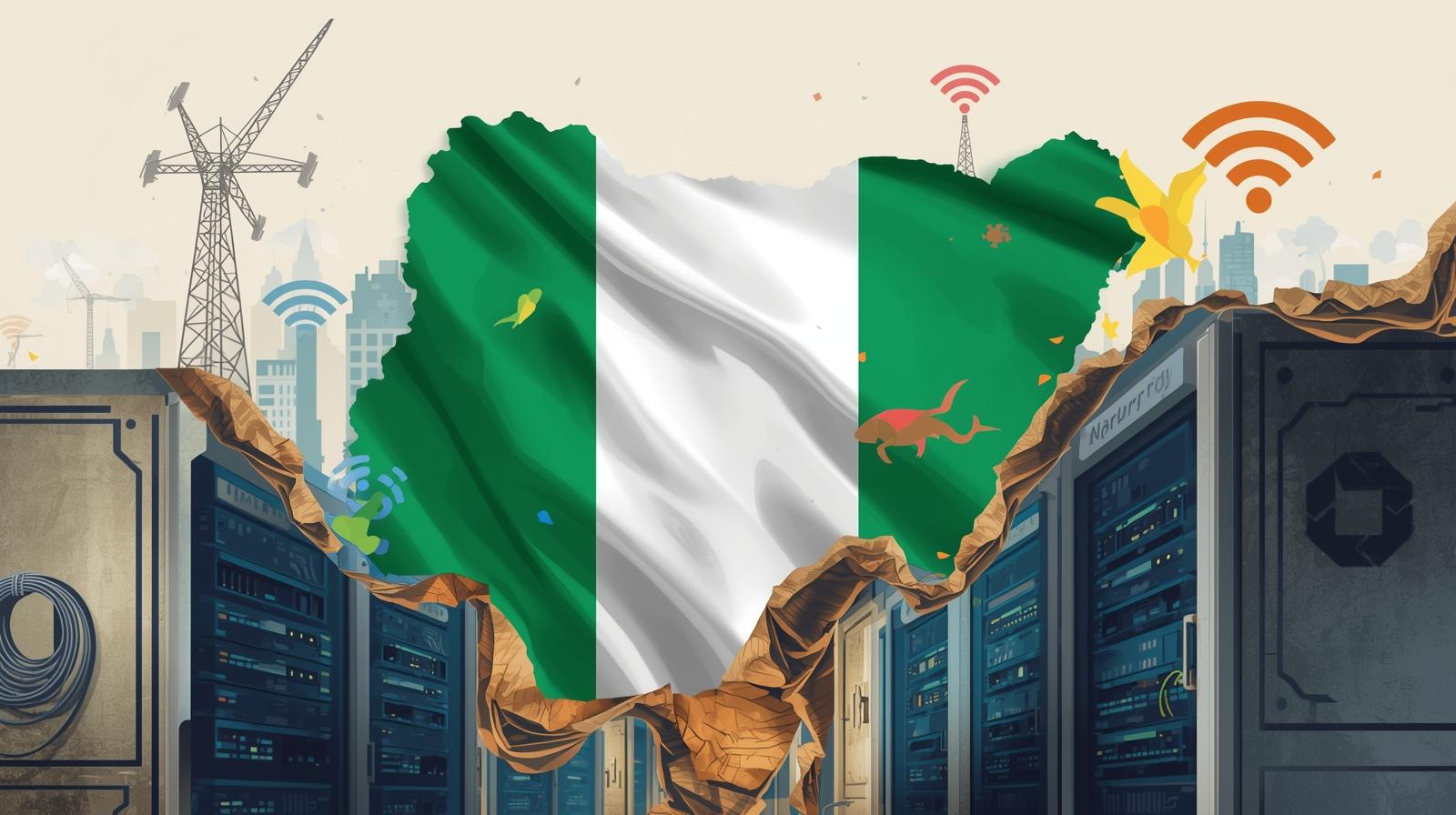
Nigeria's vibrant AI ecosystem of over 300 startups faces a critical bottleneck: the inability to train large language models locally due to severe infrastructure shortages. Despite strong technical ambition and active development of LLMs, these companies are compelled to rely on European and US data centers for training and inference, highlighting urgent gaps in domestic compute capacity and power reliability. With only 56.1 MW of total data center capacity in 2025—requiring nearly four-fold expansion by 2030—the infrastructure deficit exemplifies broader African challenges including limited compute access and power instability.
The technical implementation challenges are stark: AI startups face bottlenecks in local GPU access with grid reliability at only 5,800 MW versus 13,000 MW installed capacity, necessitating hybrid cloud-local strategies with gas/renewable backups for 98-99% uptime requirements. Model training demands massive compute resources unavailable domestically, leading to high costs and latency issues that could be addressed through edge computing for sector-specific applications in agriculture and fintech.
OpenAI Launches GPT-5.2 as It Navigates 'Code Red'
OpenAI's GPT-5.2 represents a significant leap in enterprise AI capabilities, outperforming human professionals in 70% of tasks across 44 occupations while completing them 11x faster. For African enterprises, the tiered approach—Instant for speed, Thinking for coding/math, Pro for complex accuracy—offers cost-effective access to advanced AI despite infrastructure limitations. However, rising API costs may accelerate adoption of local fine-tuning strategies and open-source alternatives.
Read MoreTrump Clears Way for Nvidia to Sell Powerful AI Chips to China
The reversal of chip export restrictions could stabilize global GPU supply chains and reduce pricing pressures, potentially benefiting African AI ecosystems through improved hardware access via secondary markets or cloud providers. This shift may create partnership opportunities with Nvidia for African data centers while highlighting the strategic importance of monitoring alternative suppliers amid geopolitical volatility in AI hardware markets.
Read MoreEU Opens Investigation into Google's Use of Online Content for AI Models
The European Commission's antitrust probe into Google's content usage for AI training signals a broader shift toward explicit licensing requirements that will affect global AI development practices. African AI firms should prepare for new content-licensing norms while potentially leveraging this shift to offer African content as monetizable, rights-cleared training data for global models, creating new revenue streams in the emerging licensed dataset economy.
Read MoreMorocco Accelerates AI Strategy With New Regulations, JAZARI Institutes and Sovereign Cloud Push
Morocco's comprehensive AI strategy through Digital X.0 law and nationwide JAZARI institutes creates stable regulatory environment for AI investment, with sovereign cloud rollout by 2026 leveraging renewable energy advantages. The establishment of regional excellence centers positions Morocco as a potential blueprint for decentralized AI development across Francophone Africa.
Read MoreAfDB Maps $1 Trillion AI Opportunity for Africa in New G20-Backed Report
The African Development Bank's G20-endorsed roadmap projects AI could add $1 trillion to Africa's GDP by 2035, with agriculture (20%) and finance (8%) leading sectoral gains. The three-phase implementation strategy (2025-2035) emphasizes five enablers—data, compute, skills, trust, and capital—creating clear investment priorities for catalytic funding and private capital deployment.
Read MoreHostinger Launches in Nigeria, Offering AI-Powered Tools for Entrepreneurs
Hostinger's Nigeria launch with AI-powered tools like Kodee (76% autonomous resolution of 855K monthly conversations) and no-code platforms demonstrates scalable AI SaaS opportunities for Africa's 41 million SMEs. The integration of local Naira payments with proven AI efficiency validates demand for affordable, localized AI tools in high-growth African markets.
Read More🤖 Forward this newsletter to colleagues interested in African AI investment opportunities
🔗 Visit Africa Insights AI for detailed AI market analysis
💡 Subscribe to our main newsletter for broader African business intelligence
© 2025 Africa Insights AI. All rights reserved.